Duux North 9K Smart Air Conditioner, Heater & Dehumidifier
220/1278
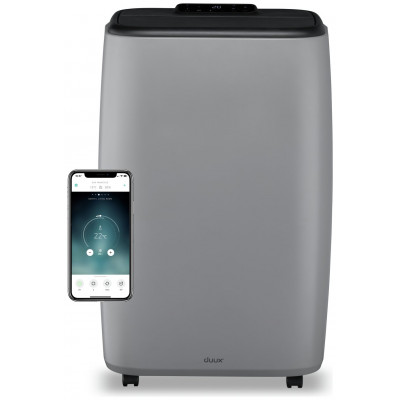
Product details
- Brand: Duux
- Catalogue number: 220/1278
- Manufacturer's number: TBA
Duux Support
Email me this page
Enter your email address to have this page emailed to you *
Useful links
Online supportFAQs
If the unit does not turn on but the lights are indicating it has power, try the following:
- Drain the water out of the drainage tray.
- Try an alternative mains plug socket.
- Disconnect the unit from power, hold down the On/Off button for 15 seconds, and then plug back in.
If the issue remains, please get in touch with the team using the contact details on this page.
If the air is not cool enough, try the following:
- Ensure any nearby windows or doors are closed.
- Ensure that the exhaust duct is correctly attached.
- Decrease the set temperature.
- Clean the air filter.
If the issue remains, please get in touch with the team using the contact details on this page.
If the unit is noisy or vibrating, try the following:
- Clean the air filter.
- Place the unit on a flat, level surface.
If the issue remains, please get in touch with the team using the contact details on this page.
If you can hear a gurgling sound, this is normal for air conditioning units as it is produced by the flowing refrigerant inside the conditioner.
Dehumidifiers remove moisture from the air, but they’re only effective within a certain volume. If your room is too large, the unit may struggle to maintain comfortable humidity levels, especially in damp weather. If the room is small and the unit is too large, it might over-dry the air or use more energy than necessary.
To find the area (how much floor space you have):
Measure the length and width of your room in metres. Then multiply those two numbers.
For example: If your room is 5 metres long and 4 metres wide, the area is 20 square metres (5 × 4 = 20m²).
To find the volume (how much space is in the whole room):
Measure the height of the room as well, then multiply length × width × height.
For example: If your room is 5 metres long, 4 metres wide, and 2.5 metres high, the volume is 50 cubic metres (5 × 4 × 2.5 = 50m³).
When positioning the dehumidifier, ensure that it is placed on a level surface and that there is a minimum of 20cm space on either side of the unit to allow for efficient airflow.
- Check the plug socket is turned on.
- Try an alternative socket.
- Change the fuse in the plug.
- Confirm it has power.
- Empty the water tank.
- Ensure the water tank is positioned correctly.
- Clean the filter. Always refer to the user manual.
- Ensure the air filter is not blocked.
- Ensure the intake duct or discharge duct is not obstructed.
Always refer to the user manual.
- Check is on a level flat surface.
- Ensure it is not tilted or unsteady.
- Clean the filter. Refer to the user manual.
Manufacturers recommend matching the cooling capacity (BTU) to the room size.
First, you will need to calculate the room volume. Measure the area of the room (length x width), then multiply that figure with the height of the room.
Below is a quick guide to help select the correct air conditioning for your room.
Room size Typical BTU requirement
10-15m² - 5000-7000 BTU
15-20m² - 8000-10000 BTU
20-30m² - 10000-12000 BTU
30m² - 12000 BTU+
Condensation is a normal by-product of cooling and dehumidifying.
Many portable air conditioners collect water internally. If the collection tank becomes full, the unit may stop operating and require draining.
If your portable air-conditioning unit is leaking water, check the following:
- Check the internal tank and empty if it full.
- Ensure the portable air-conditioning unit is placed on a level solid surface.
- Check that the drain plug is fitted correctly.
- Ensure the drain hose is not blocked or kinked.
Check your portable air-conditioning unit's instruction manual for the above procedures.
Most manufacturers recommend cleaning the air filters every two weeks when the air-conditioning unit is being used regularly,
Check your air-conditioning unit's instruction manual for how often the filter should be cleaned.
Most manufacturers generally recommend plugging the unit directly into a suitable mains socket and avoiding extension leads wherever possible because they are not designed to handle high current draw, also longer extension leads can cause voltage drops which can reduce the efficiency and lifespan of your air-conditioning unit.
Many manufacturers state that using an extension lead voids the warranty of the air-conditioning unit.
This may be normal behaviour. After the room reaches the desired temperature, the compressor may switch on and off periodically to maintain that temperature. More frequent cycling can occur if the unit is larger than required for the room or if airflow is restricted by dirty filters.
This is normal operation. Portable air conditioners remove heat from the room and vent it outside through the exhaust hose. As a result, the hose and window kit may become warm during use. For optimal performance, manufacturers recommend keeping the exhaust hose as short and straight as possible.
It is normal for condensation to collect inside the exhaust hose, particularly in humid conditions. If the unit's drainage system is operating correctly and there are no signs of water leaking externally, the presence of some moisture in the hose is generally not a cause for concern.
Yes. Portable air conditioners are designed to operate for extended periods, provided they are used and maintained correctly.
To ensure safe and efficient performance:
- Keep the filters clean.
- Ensure air inlets and outlets are not obstructed.
- Empty the water tank when required.
- Maintain the recommended ventilation clearances around the unit.
Check your portable air-conditioning unit's instruction manual for the above procedures.
Questions & answers
How-to videos
-
How to set up a dehumidifier
-
Cleaning and Maintenance on a dehumidifier
Returns policy
If you need advice or support for your product, please in the first instance contact the support provider using the number on this support page.
If you still need to return your product then please visit our most up to date returns policy here.